Internal linking strategy: the complete how-to (2026)
This guide covers strategic internal linking for 2026. Learn how to distribute link equity through topic clusters, optimise your crawl budget and understand the impact of AI on site structure. Discover how technical audits lead to 25% better indexing and stronger organic visibility for B2B and e-commerce platforms.
 Kevin Boon · 26 February 2026 · Updated 6 October 2026 · 18 min read


In 2026, search engines are making a massive shift towards AI-driven systems. That changes everything. A logical site architecture matters more than ever as a result. Without a well-thought-out internal linking strategy, these systems get lost in your content. According to a technical report by Stridec, a strong internal link structure forms the foundation of the so-called Entity Hub Model. It teaches large language models how specific topics relate to one another. The result is a better chance of being cited in clear AI snippets.
- Internal linking
- The strategic method of connecting pages within a website. This navigation structure distributes the available link equity and tells search engines directly which sub-entities and main topics matter most for your organic visibility.
Many B2B companies struggle with an unexplained loss of organic traffic. That costs leads. The problem often stems from a lack of clear structure and a shortage of technical SEO knowledge. Your most important services stay invisible when they sit on the server as isolated islands. You waste your available crawl budget in the process. As we also describe in our article on improving SEO with data, an extensive analysis by Sitebulb shows that strategically streamlining this crawl budget can lead to an actual 25% drop in the ‘Discovered Not Indexed’ error. As an SEO agency, RankPilot helps companies bring these blind spots to light. By optimising how your pages connect, you steer search engines straight to the pages that deliver the most value.
Key insights
- A well-thought-out internal linking strategy distributes the available link equity with purpose. According to the Entity Hub Model, this focused navigation structure tells search engines directly which pages matter most for your organic visibility.
- Topic clusters and content siloing determine topical relevance in 2026. Knowledge-driven SMEs grow organically through flexible clusters. E-commerce platforms with more than ten thousand products, on the other hand, demand strict siloing. This effectively prevents crawl chaos on the server.
- Automated tools work fast, but manual review prevents over-optimised anchor texts. Google's SpamBrain algorithm automatically neutralises the value of links as soon as the system detects excessive commercial keywords.
- Technical errors such as redirect loops and 404 pages drain your crawl budget at speed. Data from Sitebulb shows that optimising this budget results in a 25 percent drop in unwanted non-indexed URLs. Frequent audits are simply necessary.
- A logical link structure supports the Core Web Vitals and the mobile user experience. Documentation from Mozilla Web Docs confirms that extra internal links do not hurt load time. They do move visitors through the funnel considerably faster. This lowers the bounce rate significantly.
What is internal linking and how does PageRank work?
A successful SEO campaign needs a solid technical foundation. Internal linking forms that base because it fully dictates the architecture of your digital domain. By strategically connecting individual web pages, you create a logical web for search engine bots. You send them straight to the content with the most commercial value. Without these connections, excellent articles simply stay invisible on the server. Optimising this structure goes far beyond randomly adding links. It takes a methodical approach to guide the value you have built efficiently through the entire platform.

Steering this incoming authority effectively and improving your crawlability takes up-to-date knowledge, which you can also find in our extensive knowledge base on search engine optimisation.
- Anchor text
- The visible, clickable text of a hyperlink that tells search engines exactly which topic the target page covers.
- Link equity
- The measurable authority and SEO value that a specific web page passes on to a linked URL through a hyperlink.
- Crawl budget
- The absolute limit of URLs that a search engine bot can and will index on a domain within a set period of time.
The distribution of this authority is not guesswork; it rests on an exact mathematical model. PageRank flows through the hierarchy of your website in an iterative process, with a source page systematically splitting its accumulated value across its outgoing links. According to the original PageRank Algorithm Core Documentation from Stanford University, the algorithm uses a damping factor. This factor is set to 0.85 by default and models the statistical probability that a user keeps following the click path. The underlying formula shows that the value passed on depends directly on the total number of links on the referring page. The fewer outgoing links a high-scoring page contains, the more powerfully the remaining link equity concentrates on the chosen target pages.
Apply this mathematical principle correctly and you immediately solve structural content gaps. Pages that used to be isolated suddenly receive a targeted flow of authority. In this way, a data-driven internal linking strategy prevents valuable PageRank from leaking away to unimportant overview pages or outdated articles. Rankpilot offers services to map these hidden data flows and restructure the navigation paths. The aim is to steer the available authority in a controlled way towards the most important services and products of your business.
How do you build a strong internal linking strategy?
For B2B organisations and SMEs, setting up a scalable site structure is the absolute key to sustainable online growth. Without a clear plan, visitors and search engines quickly get lost in a digital maze of loose articles and services. A successful internal linking strategy always starts with identifying your most important commercial pages and systematically closing gaps in the content. In our blogs you regularly read how to put this authority to good use. You steer this process with hard data through regular technical audits. According to the official Screaming Frog documentation, you can easily trace missing connections by analysing the specific ‘Inlinks’ report. This lets you locate orphan pages that were previously cut off completely from the rest of your platform. That is a waste. Once this foundation is error-free, the focus shifts to the architecture.
- Topic cluster
- A flexible site structure in which a central overview page links horizontally to in-depth subpages, which in turn refer to related clusters based on semantic entity relationships.
- Content silo
- A strict, vertical and hierarchical data structure in which a main page links only downwards to relevant subpages, without creating cross-links to other sections.
Topic clusters versus content siloing
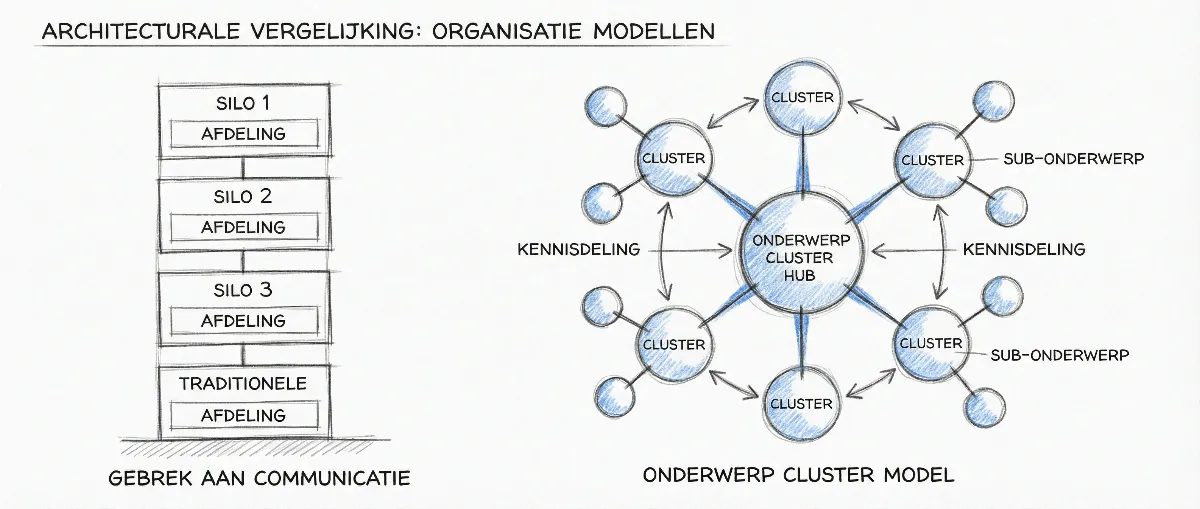
To build topical authority, you need to choose the right architecture for your specific business model. An extensive comparative publication by SEO Shouts shows that the fundamental difference between these two methods lies in the rigidity of the architecture. Where siloing results in isolated islands of information, topic clusters work as connected continents within your domain. This dynamic model is especially effective for training modern language models on your specific niche expertise.
When do you choose which method? Data from the research platform Higher Ranking shows that siloing is mainly the recommended strategy for large-scale e-commerce websites. Think of extensive digital catalogues with more than 10,000 products. For platforms like these, a rigid separation is simply necessary to prevent sprawl during crawling. It saves crawl budget. For knowledge-driven SMEs and B2B SaaS providers, such a strict hierarchy often holds back growth. These organisations need the flexibility of the cluster model to claim broad topical authority. It allows them to connect related knowledge articles and services smoothly without getting tangled up in forced URL structures.
Rankpilot supports business owners in implementing these scalable architectures and helps make complex website structures clear again. By using smart methods, we speed up the build-up of internal PageRank flow to the pages with the highest conversion value. It works remarkably fast. According to a market analysis by software developer Link Whisper, process automation eliminates hours of labour-intensive searching. Their data shows that using algorithms results in huge operational efficiency, with the number of SEO agency hours needed dropping sharply. That is how you turn a messy collection of web pages into a streamlined acquisition channel.
Impact of internal linking on UX and Core Web Vitals
A website should not only make sense to search engines, but above all to your human visitors. A well-thought-out structure guides potential customers smoothly through the digital sales funnel. When you connect relevant articles and services cleverly, a completely natural reading flow emerges. Visitors click through to related solutions much faster. In the data, this behaviour translates directly into a considerably higher time on page. At the same time, your bounce rates drop sharply, because users find exactly what they are looking for without getting frustrated on a dead-end page.
This navigation structure plays an even bigger role on smartphones. The mobile UX differs fundamentally from the spacious desktop view. On a large screen, users navigate relatively easily via wide mega menus and extensive sidebars. On mobile devices, these important elements quickly disappear behind a hidden hamburger menu. This often creates an unwanted content gap. Mobile readers miss the overall picture of what you offer. By weaving strategic text links organically into your running paragraphs, you solve this problem straight away. You keep visitors actively engaged and stay in control of the navigation, whatever the size of their screen.
An extensive link structure does sometimes raise technical concerns about a domain's raw performance. Does a surplus of links slow the website down? According to the official Mozilla MDN Web Docs documentation, not when used responsibly. Basic HTML links trigger no extra network requests and therefore have no quantifiable negative impact on the Largest Contentful Paint (LCP). The real risk only appears at extreme volumes. Pages with many thousands of internal links increase the number of DOM elements enormously. That unnecessarily heavy DOM structure slows down the browser's rendering process and can noticeably damage your Core Web Vitals. Rankpilot analyses these technical relationships in detail. We restructure your platform so the navigation works perfectly for the user, without putting needless strain on the technology behind the scenes.
Fixing broken internal links and 404 errors

Even the most carefully planned website structure is subject to technical decay. Pages are taken offline, URLs change and categories shift over time. This inevitably produces broken links. When a search engine bot runs into one of those 404 errors during a session, its journey stops abruptly. It is comparable to the loss of value from backlinks that no longer work properly. At that moment, the link equity you carefully built up drains straight into a digital black hole. You needlessly waste capacity from your available crawl budget.
Checking every single hyperlink on your platform periodically is an impossible task. Fortunately, solving these technical SEO problems is surprisingly accessible. You do not necessarily need a developer for it. The solution lies in advanced auditing software such as Sitebulb or Screaming Frog. According to the official Screaming Frog SEO Spider tutorial, you can map the full architecture and link depth of your website in no time through an automated simulation. By opening the ‘Response Codes’ tab after the scan and filtering on ‘Internal’ and the exact status ‘4xx Client Error’, the software immediately reveals the location of every broken hyperlink.
Besides pages that simply cannot be reached, an audit like this also exposes more complex disruptions. In the ‘Status Code’ column of the same tool, you easily spot slow 3xx redirect chains.
- Redirect loop
- A technical error in which two or more web pages keep redirecting to each other. The content behind them never loads in the browser and the search engine bot gets stuck immediately.
Once you have these bottlenecks in view, the repair is often a simple administrative task in the content management system. You remove the outdated URL from the running text, or you replace the destination with an active, relevant article. Solving a content gap does not require any programming knowledge either. With the specific ‘Inlinks’ report you trace orphan pages in a few clicks. These are publications without any incoming links. You then manually connect these isolated files back to your active topic clusters. Rankpilot helps organisations set up these periodic checks. That way, we make sure the underlying technology of your platform always contributes flawlessly to your online visibility.
Which tools help with your internal linking strategy?
As your website grows, managing every link by hand becomes a time-consuming job. Fortunately, you do not have to do it all yourself. Within the industry there is a clear distinction between simple manual plugins and advanced software. Standard solutions such as the open-source base of Yoast still require a lot of searching from the site manager. Modern software based on Natural Language Processing, such as Link Whisper, offers an active form of assistance that transforms the process.
What exactly does such a switch deliver? According to a published analysis by Link Whisper, the return on investment lies mainly in operational efficiency at scale. The integrated AI scans your entire database in real time for unused entity relationships and under-linked pages. This immediately eliminates hours of labour-intensive searching. In quantitative terms, the technology drastically reduces the number of SEO agency hours needed. That has a positive effect on the prices of your SEO project, simply because less manual work is needed to speed up the flow of PageRank to valuable conversion pages.
Still, full automation carries a risk. Always choose tools that give smart suggestions rather than outdated plugins that blindly turn every search term they find into a hyperlink. Automatically generating unnatural links causes problems straight away in 2026.
- SpamBrain
- Google's AI-driven algorithm that monitors manipulative link profiles automatically by precisely measuring the frequency, commercial focus and rollout speed of anchor texts.
As specified in Google's official Spam Updates documentation, AI classification modules such as IndexingDocjoinerAnchorSpamInfo continuously assess your site structure. A big mistake is over-optimising anchor texts to divert authority on purely mathematical grounds. When the algorithm detects this unnatural pattern, a direct penalty rarely follows. The system simply neutralises the value passed on by the links in question. Your optimisation then has zero effect. Rankpilot guides organisations in finding the right balance between efficient software assistance and strict human quality control.
Internal linking for e-commerce platforms
For enterprise-level online shops, a standard site structure is not enough. Once your digital catalogue passes the ten thousand product mark, a completely new technical challenge arises. It is no longer only about distributing the authority you have built, but about actively managing the limits of search engines. One of the biggest causes of this crawl chaos is the filter system on category pages.
- Faceted navigation
- An extensive filter system that lets users narrow down the product range by attributes such as colour, size or price, which often unintentionally generates thousands of unique URL combinations.
These unlimited filter combinations cause a huge sprawl of internal links. Search engine bots get tangled up in them and spend their allotted time crawling empty or heavily overlapping archive pages. This comes directly at the expense of indexing your new, profitable products. During an intake we often look straight at the technical state of large platforms like these to fix these problems. Documentation from Google Search Central and an extensive data analysis by Sitebulb show exactly how to tackle this. In a focused case study of a growing Magento shop with more than 10,000 product variants, the faceted navigation was rigorously contained. By strictly cutting off parameter-generated filters via the robots.txt file and setting thin product categories to noindex, the technicians successfully redirected the crawl budget. The data then showed an actual 25 percent drop in the stubborn ‘Discovered, Not Indexed’ error. As a result, the most important sales channels finally got the priority they deserved.
The bridge between information and transaction
Besides guarding server capacity, an e-commerce platform needs a specific method to stimulate purchase intent. A common mistake is completely isolating the informational company blog from the transactional shop environment. To convert visitors who are still exploring, you build a logical bridge between these two areas.
You achieve this by writing high-quality, problem-solving articles that directly answer your audience's questions. From this educational content, you then place strategic text links to the related commercial product categories. Preferably do not link to individual products. The range in an online shop rotates quickly. Specific items sell out or disappear from the range, which immediately produces harmful 404 errors. By consistently pointing your internal links to the stable main categories, you give these conversion-focused pages a constant and safe flow of link equity. This architecture proves the topical relevance of your platform and guides the potential buyer smoothly through the digital sales funnel.
Avoiding common internal linking mistakes
Even with a detailed strategy, technical pitfalls lie in wait. Many companies unknowingly make choices that directly slow down their organic visibility. A successful internal linking strategy requires you to know exactly which methods and actions backfire in practice.
An absolute no-go in search engine optimisation is over-optimising anchor texts. It is tempting to give every link your main commercial keyword. According to Google's official Spam Updates documentation, however, the AI-driven SpamBrain algorithm monitors this behaviour continuously. Classification modules such as IndexingDocjoinerAnchorSpamInfo measure the frequency and commercial focus of your internal links very precisely. As soon as the system detects manipulative patterns, it rarely hands out a direct penalty. It simply neutralises the link equity passed on. On top of that, placing an excessive number of links on one page hurts load time. As the technical guidelines in Mozilla's MDN Web Docs show, basic HTML links pose no risk, but extreme volumes of thousands of links per URL considerably enlarge the overall DOM structure. That has adverse consequences for your Core Web Vitals.
Another common technical problem arises with JavaScript-based menus and buttons. Search engine bots rely primarily on clear <a> tags to discover your content. When internal links load exclusively through JavaScript events, you unintentionally block the crawlability of your platform. The bot often cannot follow the targets behind them, so important sections remain unindexed.
Especially on large online shops with more than 10,000 products, this technical invisibility leads directly to a major danger for the site structure: the orphan page.
- Orphan page
- A publication or web page within a domain that receives no incoming internal links at all and therefore functions as a completely isolated file on the server.
Without connections, you waste the full potential of the published content. As an SEO specialist in Groningen we regularly see these mistakes at local and national businesses. During a technical audit with the Screaming Frog SEO Spider, you track down these isolated files straight away via the specific ‘Inlinks’ report. By identifying these pages and weaving them logically into your existing topic clusters after all, you close the gap in your content and restore the flow of authority. Rankpilot helps organisations find and fix these specific pitfalls. We analyse the underlying technology and streamline the navigation, so search engines can always process your full range without errors.
Frequently asked questions about internal linking
What is the maximum number of internal links I can place on one page?
What is the difference between internal links and backlinks?
Does an internal link in the footer carry the same value as one in the text?
How often should I check my internal link structure?
Conclusion: get more out of your existing content
A well-thought-out internal linking strategy is the foundation of the online visibility of ambitious B2B companies. By connecting web pages logically, you lead search engines and potential customers straight to the services that deliver the most value. This supports better positions in the organic search results and drives targeted lead generation. Streamlining this architecture is by no means a one-off task. As a platform grows and new articles go live, your internal linking needs ongoing maintenance and attention.
Ignoring these connections simply leaves valuable conversions untapped. Data from Link Whisper shows that actively optimising the website structure considerably speeds up the flow of PageRank to high-converting pages. This immediately increases operational efficiency for SMEs. Get in touch with Rankpilot to improve the structure of your website. We map the hidden bottlenecks of your domain and restructure the navigation for an optimal flow. Want to talk strategy right away? You can also book a free intro call with one of our specialists.
{
“@context”: “https://schema.org”,
“@graph”: [
{
“@type”: “Organization”,
“@id”: “https://rankpilot.nl/#organization”,
“name”: “Rankpilot”,
“url”: “https://rankpilot.nl/”,
“logo”: {
“@type”: “ImageObject”,
“@id”: “https://rankpilot.nl/#logo”,
“url”: “https://rankpilot.nl/wp-content/uploads/logo.png”,
“contentUrl”: “https://rankpilot.nl/wp-content/uploads/logo.png”,
“caption”: “Rankpilot”
},
“image”: {
“@id”: “https://rankpilot.nl/#logo”
}
},
{
“@type”: “BlogPosting”,
“@id”: “https://rankpilot.nl/internal-linking-strategie-seo/#article”,
“isPartOf”: {
“@id”: “https://rankpilot.nl/internal-linking-strategie-seo/”
},
“author”: {
“@id”: “https://rankpilot.nl/#organization”
},
“headline”: “Internal linking strategy: the complete how-to (2026)”,
“datePublished”: “2026-02-25T08:00:00+01:00”,
“dateModified”: “2026-02-25T08:00:00+01:00”,
“mainEntityOfPage”: {
“@id”: “https://rankpilot.nl/internal-linking-strategie-seo/”
},
“publisher”: {
“@id”: “https://rankpilot.nl/#organization”
},
“description”: “Internal linking: discover the strategy for 2026. Distribute link equity smartly, improve your crawl budget and raise indexing by 25%. Optimise now!”,
“image”: [
“https://lh3.googleusercontent.com/d/1syYttsAAx9yGcjt1Wz8Mk9WCSbn9Dsgd=w1200-rw”,
“https://lh3.googleusercontent.com/d/1zuLjD5W1HKNCBzai4DPyO-4mH-2Zu4jy=w1200-rw”,
“https://lh3.googleusercontent.com/d/18OBofkUYpgLl-5N6NzO2K-9dD2UtB6eC=w1200-rw”,
“https://lh3.googleusercontent.com/d/1RSDPpqzgwrDdH0mxfU8Kf9wQxl61I4JA=w1200-rw”
],
“inLanguage”: “en-GB”,
“keywords”: “Internal linking, SEO strategy 2026, PageRank, Link equity, Crawl budget, Topic clusters, Content siloing”
},
{
“@type”: “FAQPage”,
“@id”: “https://rankpilot.nl/internal-linking-strategie-seo/#faq”,
“mainEntity”: [
{
“@type”: “Question”,
“name”: “What is the maximum number of internal links I can place on one page?”,
“acceptedAnswer”: {
“@type”: “Answer”,
“text”: “There is no hard quantitative limit. According to documentation from the Mozilla MDN Web Docs, basic HTML links cause no direct slowdown. Extremes of many thousands of links per URL do weigh down the DOM size considerably. That damages the Core Web Vitals. So only place links that genuinely add navigational value for your visitor.”
}
},
{
“@type”: “Question”,
“name”: “What is the difference between internal links and backlinks?”,
“acceptedAnswer”: {
“@type”: “Answer”,
“text”: “Internal links connect the publications within your own domain. They distribute the authority you have built in a structured way. According to mathematical research from Stanford University, the algorithm uses a fixed damping factor of 0.85 for this. Backlinks are incoming links from external websites to your platform.”
}
},
{
“@type”: “Question”,
“name”: “Does an internal link in the footer carry the same value as one in the text?”,
“acceptedAnswer”: {
“@type”: “Answer”,
“text”: “No. Search engines give considerably more weight to contextual links woven organically into your main text. The SpamBrain algorithm analyses the location and commercial focus of every anchor text very precisely. Links in a massive footer are primarily seen as navigation aids. As a result, they pass considerably less active SEO value to the selected target page.”
}
},
{
“@type”: “Question”,
“name”: “How often should I check my internal link structure?”,
“acceptedAnswer”: {
“@type”: “Answer”,
“text”: “A periodic technical audit is simply essential. With analysis tools such as the Screaming Frog SEO Spider, you easily filter on the 4xx Client Error status to repair broken connections straight away. Data from Sitebulb shows that consistently streamlining your website structure results in a 25 percent drop in unwanted non-indexed URLs.”
}
}
]
}
]
}
Contents
- Key insights
- What is internal linking and how does PageRank work?
- How do you build a strong internal linking strategy?
- Impact of internal linking on UX and Core Web Vitals
- Fixing broken internal links and 404 errors
- Which tools help with your internal linking strategy?
- Internal linking for e-commerce platforms
- Avoiding common internal linking mistakes
- Frequently asked questions about internal linking
- Conclusion: get more out of your existing content