Content marketing trends 2026
The key content marketing trends for 2026 mark a strategic shift from scattered AI experiments to AI-native operations.
 Kevin Boon · 13 May 2026 · Updated 13 November 2026 · 14 min read

AI marketing grows up in 2026
The key content marketing trends for 2026 mark a strategic shift from scattered AI experiments to AI-native operations. This year, Dutch marketers are changing from traditional traffic hunters into specialists in Generative Engine Optimization (GEO) and builders of conversations. Where the focus used to be on producing as many articles as possible, it is now about visibility in AI search engines (AI SEO) and building authority through human direction.
Key insights
What to remember
The main points from this article, brought together in a more visual overview.
72% of marketers are increasing budgets for technology integration
The move from ‘making content’ to ‘building authority’
The shift from AI experiments to AI-native operations

This rethink is a hard necessity for businesses that want to stay relevant online. Data from Averi.ai (2026) shows that 89% of B2B buyers use generative AI during the buying process. Visitors no longer look for a list of blue links; they expect a consolidated answer straight away through systems such as Perplexity or Google’s SGE. To respond to this, 72% of marketers are currently increasing budgets for technology integration. Attention is shifting to signal-based marketing, where consumers in a time of AI fatigue respond to clear signals of trust and first-party data, rather than anonymous mass distribution.
Visibility in these new overviews needs a different technical approach. Rob Glover, senior copywriter at WordStream (2026), argues that zero-visit visibility will be the most influential development of the year. LLM referral traffic recently grew by 800% year on year. To appear in AI answers, you need a tight on-page structure, enriched with multimedia and real information gain. Generic copy without a unique angle misses out.
Despite far-reaching automation, the human factor remains what sets you apart in the market. Hybrid ‘humAIn’ teams are emerging, where AI agents work largely autonomously within preset boundaries as the operating system, while marketers focus on emotion, narrative and E-E-A-T. The trust paradox is that authority no longer comes from clinical perfection, but from openly showing the human process. This pays off in practice. An NP Digital study (via Alice Violet Creative, 2026) shows that human-led content attracts 5.44 times more traffic than purely AI-generated pieces. Businesses looking for this balance can streamline their processes smartly. Find out how SEO automation delivers maximum ROI when human strategy and AI efficiency come together properly.
The rise of humAIn teams makes AI the operating system of your editorial team in 2026
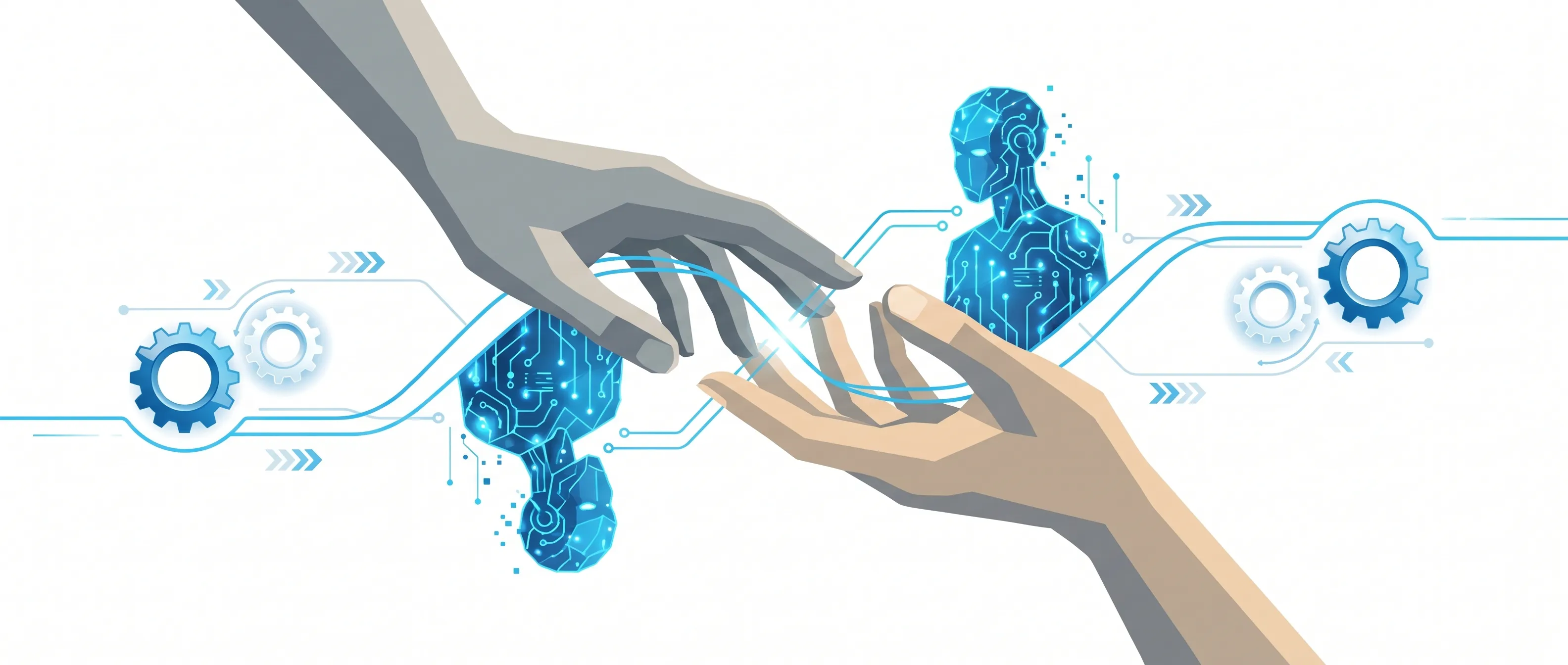
A humAIn team is a hybrid editorial team in which human creativity works alongside autonomous AI agents that act as the operating system of your marketing. Instead of typing one-off prompts, you build AI agents in as permanent team members. These systems run complex workflows such as content creation, campaign management and data analysis largely autonomously within preset boundaries. As a result, the human editor shifts from hands-on copywriter to content curator and strategist, with a strong focus on authenticity and emotional connection.
This year, their use is quickly moving towards specialised agents for autonomous processes.
From separate tools to an integrated AI operating system
The days of fragmented experiments are over. AI is developing from a simple productivity tool into an orchestration system that transforms entire workflows and keeps publications consistently on-brand. Within the content marketing trends for 2026, this is a defining shift. Businesses are setting up their editorial teams with modular systems through platforms such as n8n and GPT AgentKit.
Experts at the Content Marketing Institute (2026) describe this development well. They say that where 2024 was all about adoption and 2025 revolved around no-code agents, 2026 is the year everything comes together in support teams with agentic workflows. The software generates the outlines and first drafts, after which the system analyses performance straight away for further optimisation.
The new division of roles between people and machines
This AI-native marketing calls for a clear redistribution of tasks. While the machine handles structure, machine readability and iteration, people add the expertise and perspective that are needed. Because the widespread use of AI made standard output average last year, it is now up to marketers to stand out through signal-based marketing and in-depth E-E-A-T profiles.
A hybrid approach simply saves time. Especially at high production volumes, automation helps cut down manual work. Read how agencies and freelancers scale their SEO services with RankPilot's AI automation, so that there is more room left for strategic thinking in day-to-day work.
Why GEO is becoming more important for your visibility than traditional SEO in 2026
Generative Engine Optimization (GEO) is the strategy for maximising online visibility in AI-driven search engines such as ChatGPT, Perplexity and Google’s AI Overviews. Where traditional SEO focuses on generating clicks through blue links, GEO is about winning citations and source mentions in direct AI answers. This shift to ‘zero-visit visibility’ is a defining factor in the content marketing trends for 2026, because platforms give answers directly in the interface without users needing to click through.
Search behaviour in the business market is changing fast. This means your brand needs to be present in the training data and current answers of these models to be considered by your audience at all.
Quick overview
This shift to ‘zero-visit visibility’ is a defining factor in the content marketing trends for 2026, because
At the same time, they saw referral traffic from Large Language Models grow by 800% compared with last year.
Zach Chmael, Head of Marketing at Averi.ai, therefore states in 2026: “Generative Engine Optimization (GEO) is now essential alongside traditional SEO.
Direct AI answers are replacing traditional search results
In AI-driven search engines, zero-click answers dominate, which leads to a drop in traditional organic traffic for informational search terms. To stay visible, the focus is shifting from mass distribution to signal-based marketing. Consumers and AI models look for direct signals of trust, such as in-depth E-E-A-T profiles and unique first-party data. Zach Chmael, Head of Marketing at Averi.ai, therefore states in 2026: “Generative Engine Optimization (GEO) is now essential alongside traditional SEO.”
| Feature | Traditional SEO | Generative Engine Optimization (GEO) |
|---|---|---|
| Primary goal | Generating clicks to the website | Citations in AI answers (zero-visit visibility) |
| Focus area | Keywords and backlinks | Intent matching and authority signals |
| Measuring success | Position in search results | Mentions by LLMs and Perplexity |
How to increase your brand's visibility in AI engines
To keep organic traffic, GEO calls for an adjusted approach to your publications. Build authority with specifically structured content that models can easily process and interpret. Also enrich your copy with media as standard. Stephanie Yoder, Director of Content at Rebrandly, stresses via Wordstream (2026): “Multimedia content increases visibility in AI answers.” Think of video transcripts and clear schema markup that strengthen the AI context. Specific, authoritative content can increase visibility in AI responses by up to 40% (Averi.ai, 2026).
Visibility is now less about the top position and more about mentions in systems such as Perplexity and SGE. That calls for a technical and editorial review of existing copy. Want to know whether a website fits these AI-driven search engines? Request your 5 free improvement points and see how we align your current content with these new indexing methods.
Authenticity is the scarcest asset in the content marketing trends of 2026
The huge increase in AI-generated copy creates a trust paradox: more content leads to more distrust among readers. Within the content marketing trends of 2026, authenticity has become the scarcest asset. Search engines and readers actively look for human experience and unique expertise as a filter against the flood of generic information. Showing your actual process, including the choices you made and your strategic doubts, signals a humanity that algorithms simply cannot imitate.
The need for human verification and proof
Copy that comes entirely out of an AI generator delivers less and less visibility. Search engines and platforms look at organic interaction to judge whether a text is accurate and relevant. That makes review by a human editor important again. Being open about AI use is fine, as long as the content leans on practical experience. In effect, the algorithm enforces that authenticity.
Quick overview
The trust paradox: more content leads to more distrust
The huge increase in AI-generated copy creates a trust paradox: more content leads to more distrust among readers.
Within the content marketing trends of 2026, authenticity has become the scarcest asset.
Ready for the next step?
Want to know what the content marketing trends for 2026 mean in practice for your situation? RankPilot is happy to think along about the right approach, next steps and priorities.
Request your 5 free improvement pointsWithin the E-E-A-T guidelines, demonstrable expertise carries a lot of weight for your eventual position. Search algorithms look specifically for human additions, such as verified sources and your own angle. That calls for depth rather than steering purely on quantity. Organisations that calculate the costs of content creation therefore more often focus on signal-based marketing, built around factual data and verifiable quality.
Building a community on your own platforms
Besides expertise, where you publish plays a big role. Owned media give you the control you need to build a credible brand. Because third-party cookies are disappearing and AI search engines increasingly scrape answers, 72% of marketers now build their strategies around first-party data (Averi.ai, 2026). This specific data lets you share highly targeted and accurate stories that connect directly with your audience.
Integrating user-generated content and real customer stories on your own platforms gives a level of credibility that standard corporate communication does not reach. An active community creates organic interaction, which is a strong trust signal for algorithms. As Depositie.nl (2026) puts it: “Authenticity is not in perfection. It is in being consistent.”
Key takeaways on content marketing trends 2026
- The flood of AI content creates a trust paradox in which human expertise is the only thing that sets you apart.
- Human-written content generates more than five times as much traffic as purely AI-generated copy.
- First-party data and owned media form the stable foundation for a reliable E-E-A-T strategy in 2026.
Within the content marketing trends of 2026, video calls for a conscious choice between ultra-short and in-depth long-form
This year, video marketing is polarising strongly towards two extremes of the customer journey. You either choose ultra-short, vertical clips to grab attention, or long, authentic sessions to build authority. The middle ground of slick, generic corporate videos is losing its effectiveness. This shift forces brands to strictly separate their video production by goal: reach or conversion.
Ultra-short video for quick brand awareness
For quick visibility and signal-based marketing, ultra-short video is the primary tool. Platforms such as TikTok, Instagram Reels and YouTube Shorts reward content that gets straight to the point. Data from Visla (2026) shows that 71% of marketers name short-form video as the best-performing format. Viewers are 2.5 times more likely to watch videos of 15 to 90 seconds all the way through (Shoutoutstudio.com, 2026). This format acts as the visual hook in an AI-native marketing approach. You grab attention with a sharp message, without selling aggressively. Video ROI rises because AI-driven editing makes it possible to generate dozens of optimised micro-clips from one long recording.
Long-form content for authority and conversion
Where short clips create reach, long-form content builds the E-E-A-T signals needed for Generative Engine Optimization. Consumers look for depth and real expertise as an antidote to superficial AI answers. In-depth product walkthroughs, founder-led stories and live Q&As create a strong bond with the brand.
Averi.ai (2026) is clear about this: founder-led talking heads perform better than polished corporate videos. Human authenticity builds trust in a time of AI fatigue. Hybrid humAIn teams use autonomous AI agents for technical distribution and optimisation, while the human speakers focus fully on emotion and narrative. This split saves you production time while safeguarding the quality of your in-depth SEO content and video productions.
Within the content marketing trends of 2026, the focus shifts to signal-based marketing and community-driven content
Signal-based marketing prioritises authenticity and direct trust signals, such as citations and human emotion, over pure reach. Consumers spot AI-generated copy very quickly and increasingly act on intuition. Your content therefore has to feel credible immediately. This means a hard shift from mass distribution to precision, where relevance to specific communities is decisive.
Hyper-personalisation through first-party data
CRM data forms the basis for this personalised, contextual approach. Because third-party cookies are disappearing, you make up for falling reach signals by analysing customer interactions, purchase history and feedback from your own systems. You no longer segment purely on demographics, but on emotion and intent. Averi.ai (2026) states that 89% of B2B buyers use generative AI in purchase decisions, strongly driven by CRM-personalised content. Traditional search volumes are falling by 25% due to zero-click searches, which makes this owned data the fuel for Generative Engine Optimization (Signal AI, 2026).
You put this data to work through a fixed process to refine your strategy:
- Extract CRM data: Analyse specific purchase paths and engagement scores to keep sharpening your buyer personas.
- Integrate AI agents: Connect these insights to autonomous systems for dynamic content creation and personalisation across multiple channels.
- Test and optimise: Run targeted A/B experiments with a sharp focus on conversion and customer retention.
The community as the engine of your content machine
An active community feeds your content strategy with authentic interactions. You use users' questions and discussions as direct input for new publications, instead of broadcasting one way. This creates an ecosystem of trust in which your content matches exactly what your audience actually cares about. AI considerably speeds up the execution of this strategy.
Still, human insight remains decisive for tone and narrative. While AI agents process the data and automate workflows, hybrid teams provide the emotional connection. For businesses that want to grow efficiently through SEO automation, this combination of CRM data, smart systems and community feedback offers the most robust route to lasting online authority.
Frequently asked questions about the content marketing trends of 2026
How to keep your content strategy relevant in the second half of 2026
The move to AI-native marketing calls for a different allocation of your budgets and editorial processes. To apply the content marketing trends for 2026 effectively, the focus shifts from mass distribution to signal-based marketing. In a time of AI fatigue, consumers only respond to direct signals of trust and authority. This means your editorial capacity shifts towards precision and a strong focus on your own community.
Generative Engine Optimization and human authority together form the winning combination for the years ahead. You build E-E-A-T by being open about your strategic choices and showing the human process behind the publication. Within successful humAIn teams, autonomous AI agents act as the operating system for data processing, while human editors focus on the narrative. That calls for targeted investment.
Assess right away which resources you allocate to this new infrastructure and to formats with a positive video ROI. A thorough content audit is a logical first step here to map out your current position and prepare your planning for 2027. See how to set up your processes more efficiently and scale your SEO services with the AI automation that suits your organisation. Request your 5 free improvement points from RankPilot for immediate insight into the next steps your brand needs.
Key takeaways on content marketing trends 2026
- The shift to Generative Engine Optimization calls for a focus on zero-visit visibility in AI overviews.
- Hybrid humAIn teams combine autonomous AI agents as a foundation with human creativity for the narrative.
- Signal-based marketing and first-party data are replacing traditional mass distribution.
- A timely content audit is needed to set up budgets and processes for 2027 in the best way.
Sources and fact check for content marketing trends 2026
The claims and figures in this article have been checked against these external sources.
- Averi.ai (2026) : This rethink is a hard necessity for businesses that want to stay relevant online.
- Content Marketing Institute (2026) : Experts at the Content Marketing Institute (2026) describe this development well.
- Visla (2026) : For quick visibility and signal-based marketing, ultra-short video is the primary tool.
- WordStream (2026) : Visibility in these new overviews needs a different technical approach.
- Content Marketing Trends for 2026: Humanity, Purpose and Patterns : How are the content marketing trends of 2026 changing the marketer's role?
- Video Marketing Trends for 2026: New Tech + Real Results : How do you integrate video into a GEO strategy?
- Content Marketing Trends, AI in Marketing, Backyard Studios : How are the content marketing trends of 2026 changing the marketer's role?
- 5 Winning Tactics for Short-Form Video Marketing Trends in 2026 : Which video format delivers the highest ROI in 2026?
- Content Trends 2026 Marketing Strategy | Blue Interactive Agency : How do you set up an editorial team with AI as its foundation?
- Contentmarketing in 2025: Jouw content gids (Brandfirm) : What is the shortest factual definition of the content marketing trends for 2026, and which distinguishing feature goes with it?
Contents
- AI marketing grows up in 2026
- The rise of humAIn teams makes AI the operating system of your editorial team in 2026
- Why GEO is becoming more important for your visibility than traditional SEO in 2026
- Authenticity is the scarcest asset in the content marketing trends of 2026
- Within the content marketing trends of 2026, video calls for a conscious choice between ultra-short and in-depth long-form
- Within the content marketing trends of 2026, the focus shifts to signal-based marketing and community-driven content
- Frequently asked questions about the content marketing trends of 2026
- How to keep your content strategy relevant in the second half of 2026
- Sources and fact check for content marketing trends 2026